Ion Exchange Water Softening: How It Works and Why It's Essential for Utah
Understanding resin beads, salt regeneration, and the science of softening hard water
Ion Exchange Water Softening: How It Works and Why It's Essential for Utah
Video walkthrough coming soon
How ion exchange water softening works
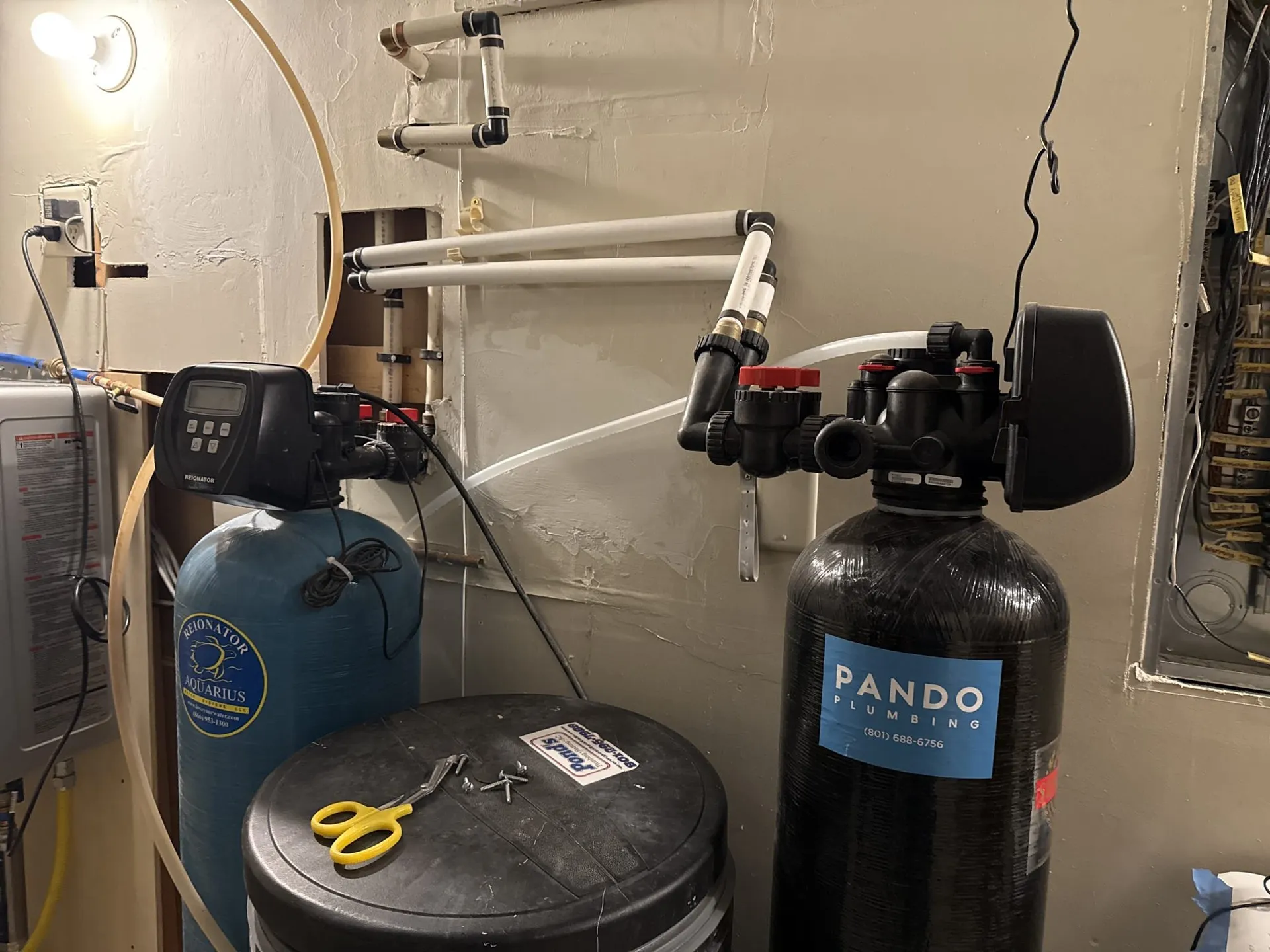
Water softening using ion exchange is a chemical process where hard water passes through a tank containing plastic resin beads. The beads are positively charged and coated with sodium ions. When hard water (containing calcium and magnesium ions) contacts the beads, the calcium and magnesium are attracted to the resin and trade places with the sodium. The water that exits the softener is 'soft' (free of calcium/magnesium) but contains slightly elevated sodium. The resin beads become saturated with calcium/magnesium over time. When saturation occurs (typically after 10,000-25,000 gallons depending on water hardness and capacity), the softener enters regeneration — a process that flushes salt brine through the resin, washing away trapped minerals and recharging the beads with sodium. Then the softener resumes softening. This cycle repeats indefinitely.
Resin beads and regeneration cycles
Modern softener resin beads are 4-8 millimeters in diameter, made of styrene-divinylbenzene copolymer. The beads contain millions of functional groups where ion exchange occurs. Regeneration happens either on a timer (every 3-5 days regardless of use) or on demand (when the resin becomes saturated). Demand-initiated regeneration is more efficient because it only regenerates when needed. For a family of 4 in 2,000 gpg water, regeneration might occur weekly. A typical regeneration uses 40-75 pounds of salt and 35-50 gallons of water. The brine (concentrated salt water) flushes through the resin, displacing trapped calcium/magnesium. Fresh resin beads are then ready for another 10,000-25,000 gallons of softening. Resin lasts 10-15 years before degradation requires replacement.
Salt types: solar salt vs rock salt vs pellets
Three salt types are used for softener regeneration: (1) Rock salt (halite) — least expensive, mined from salt deposits, often contains insoluble impurities that accumulate in brine tank. (2) Solar salt — produced by solar evaporation of seawater, higher purity than rock salt, moderate cost. (3) Evaporated salt pellets — highest purity, most expensive, minimal tank residue. Most Utah softeners use rock salt due to cost. However, rock salt's impurities accumulate in the brine tank, eventually requiring manual tank cleaning. Solar salt costs 20-30% more than rock salt but requires less maintenance. Evaporated pellets cost most but eliminate manual cleaning. For simplicity, many people choose pellets despite higher cost. In Utah's dry climate, tank maintenance is less of an issue than in humid regions where salt bridging (hardened salt clumps preventing brine) is common.
Regeneration frequency and efficiency
Regeneration frequency depends on: (1) Daily water usage — more water used means more frequent regeneration. (2) Water hardness — harder water (higher gpg) means faster resin saturation. (3) Softener capacity (grains) — larger capacity means fewer regenerations. For a typical household of 4 using 300 gallons/day in 200 gpg water, regeneration occurs weekly. Demand-initiated softeners optimize frequency by regenerating only when needed. Timer-based systems regenerate on fixed schedules (every 3 days, every Friday at 2 AM, etc.) and can waste salt and water if the schedule doesn't match actual usage. Modern efficient softeners are demand-initiated, use 25-35 pounds of salt per regeneration, and waste minimal water. Older softeners can use 50-100 pounds of salt per regeneration and waste 100+ gallons of water. Upgrading to an efficient softener in high-hardness areas pays for itself through salt/water savings.
Softener sizing and Utah water hardness
Proper softener sizing depends on water hardness (grains per gallon) and daily household water use. Utah hardness ranges 150-350+ gpg depending on location — Salt Lake City and northern areas average 200-250 gpg (very hard). A family of 4 uses 250-400 gallons daily. For 250 gpg water and 300 gallons daily, a softener needs minimum 30,000-40,000 grains capacity. Many installers recommend oversizing slightly to handle weekend houseguests or excess use. An undersized softener regenerates constantly, wasting salt and water. An oversized softener regenerates less frequently (more efficient) but costs more. Professional water softener sizing includes hardness testing (if not done through Utah State University Extension or county health department) and usage calculation. A properly sized softener prevents scale buildup in water heaters, washing machines, and plumbing — premature replacement of those components from hard water damage can run $2,000-5,000. For softener installation pricing on your home, we'll quote on-site, or use our self-help guide at /self-help.
Have questions? We're here to help.
Our licensed technicians serve Utah County, Salt Lake County, and surrounding areas.
Official Resources
Talk to a licensed technician about your specific situation — no pressure, no obligation.
Call (801) 407-9320