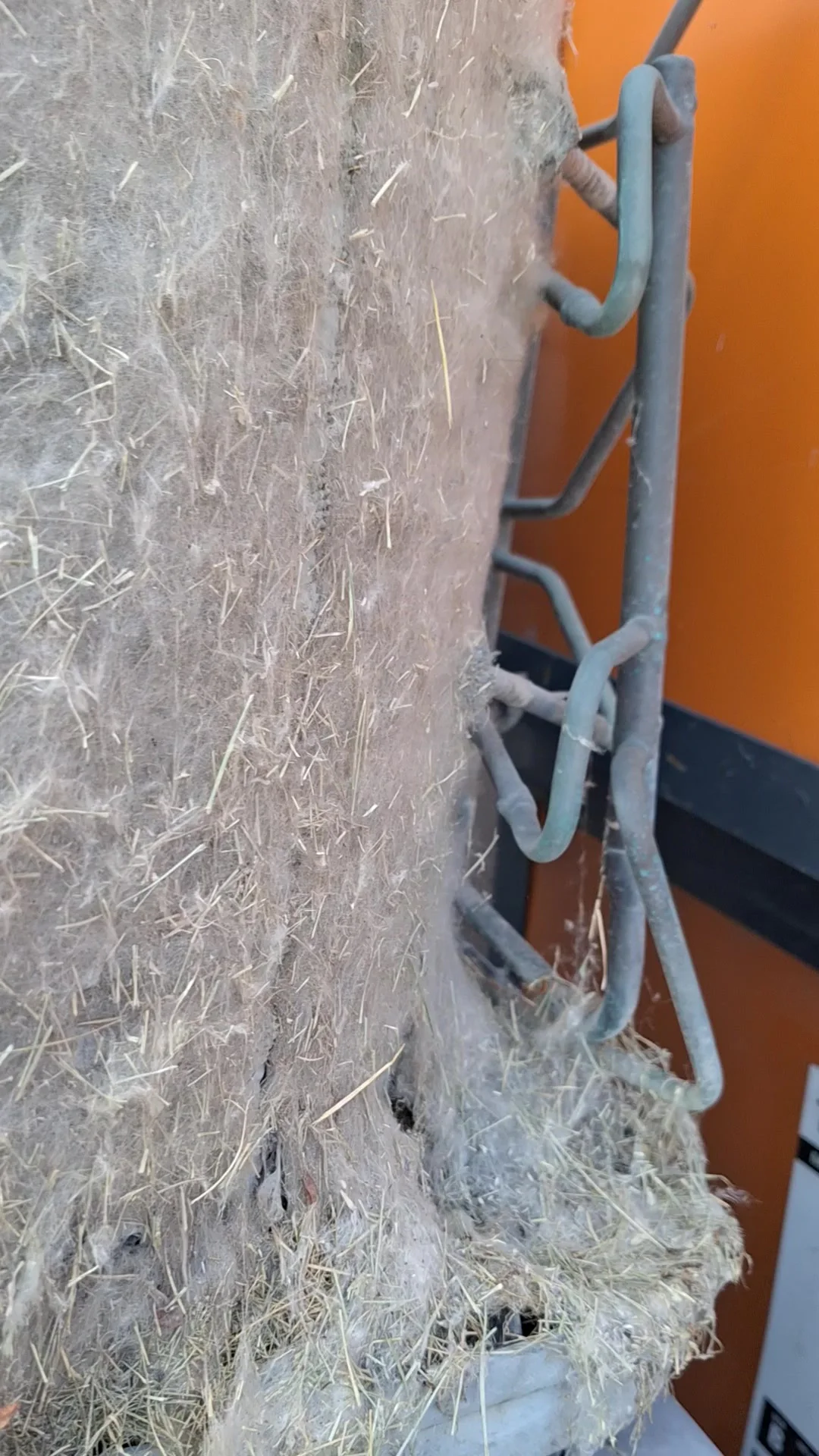
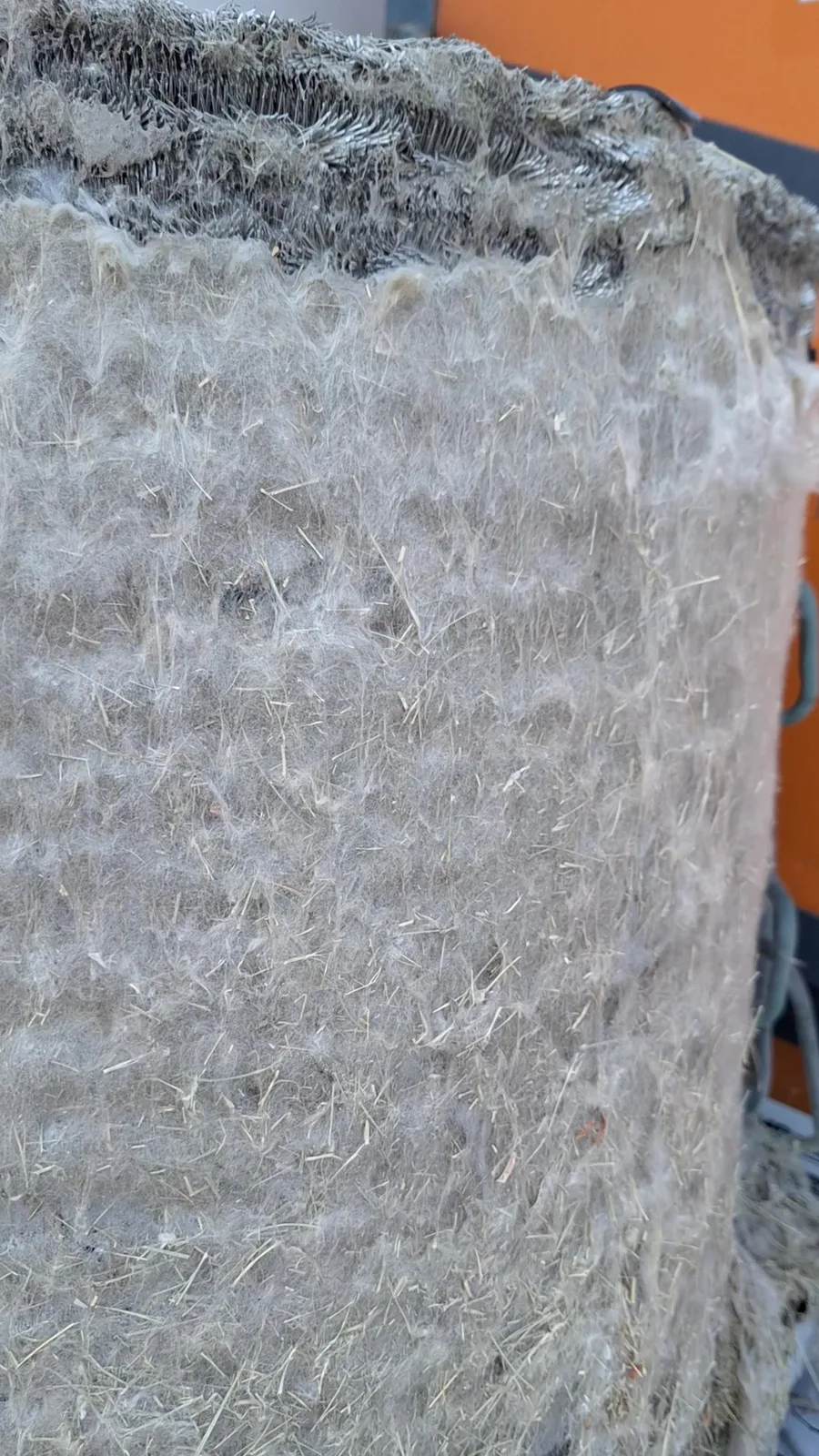
If you live anywhere along the Wasatch Front — Provo, Orem, Lehi, Sandy, Salt Lake, all the way up to Layton — and you haven't looked at the back of your air conditioner since last summer, the photo at the top of this post is what's almost certainly happening behind your AC right now. That's a real condenser coil we pulled apart in early May 2026, packed wall-to-wall with cottonwood fluff, foxtail seeds, and dryer-lint-grade dust. The unit was running; the homeowner had no idea.
Cottonwood season in Utah runs from late April through mid-June. The female cottonwood trees release millions of cotton-like seed tufts that drift on the breeze, blanket lawns, and — critically — get pulled into the side of every outdoor AC condenser within a half-mile radius. Foxtail grass in unmaintained yards adds another layer. Within four to six weeks, a unit that started the season clean can be 60–80% blocked. Most homeowners don't notice until July, when the AC starts struggling to keep up on a 95°F afternoon and the bill jumps $40–80.
What Cottonwood Actually Does to a Condenser Coil
Your outdoor condenser is a heat exchanger. The compressor pumps hot, high-pressure refrigerant through aluminum fins, and the fan pulls outside air across those fins to dump the heat into the atmosphere. That's the entire point of the unit — heat dump. When the fins are coated in fluff, three things happen at once.
Airflow drops. The fan motor is rated for a specific static pressure; when fluff blocks the inlet, the motor draws more amps trying to move the same air, runs hotter, and ages faster. We routinely see capacitors fail in late July on units whose coils never got cleaned in spring — the capacitor was the weak link in a chain stressed by months of restricted airflow.
Head pressure rises. With less air crossing the fins, refrigerant can't dump its heat efficiently, so it stays hotter and at higher pressure on the high side. High head pressure cooks lubricating oil in the compressor, accelerates valve wear, and trips the high-pressure safety switch on the worst days — which is why “the AC just shuts off and won't restart for 20 minutes” is one of the most common July service calls we run in Utah County.
Efficiency tanks. The U.S. Department of Energy estimates a dirty condenser coil reduces system efficiency by 5–15%. In our experience on Utah jobs, the worst cases — like the one in this photo — easily hit 25–35%. That means a system that should pull 4 amps at the compressor is pulling 5.5 amps. Your AC still works, but every hour it runs costs more, and your 14 SEER2 unit is performing like a 10 SEER unit from the early 2000s.
Why Utah Is Worse Than Most Places
Three local factors stack up against your AC:
- Cottonwood density. The Wasatch Front is one of the densest cottonwood corridors in the West. Mature trees shed for 4–6 weeks. Newer subdivisions in Saratoga Springs, Vineyard, Eagle Mountain, and Herriman have aggressive landscaping with thirsty trees that thrive on irrigation, which means more cottonwoods every year.
- Elevation. At 4,500–5,500+ feet in most of our service area, air is already 12–18% thinner than at sea level. Your AC is moving less mass per cubic foot of air to begin with. Restrict the airflow on top of that and the cooling-capacity loss compounds — a 10% airflow reduction at altitude hurts more than the same restriction in Texas.
- Dust season. Late April through June is also Utah's worst dust season. The lake-effect winds from the Great Salt Lake and the Utah Lake basin pick up fine sediment — including the playa dust that drifts in from the receding lakeshore — and deposit it everywhere outdoor air filters live. Cottonwood fluff catches that dust, and you end up with a felt-like mat that water alone can't penetrate.
How to Tell If Your Coil Is Choked (Without Tools)
Walk to your condenser. It's the metal box outside, usually on a small concrete pad near the side of the house. Look at the side panels — those are the coil fins. They should look like the inside of a car radiator: clean vertical aluminum lines you can see through.
If you see fluff or matted fuzz in the fin gaps, you have buildup. Run your hand a few inches above the top — that's where the fan exhausts. If the air feels weak compared to the noise the unit is making, airflow is restricted. Listen: a strained, grunting compressor that cycles on and off rapidly is the audible version of the problem.
If you can't see daylight through the fins from the outside, the coil is at least 50% blocked. If a flashlight beam doesn't make it through at all, you're likely 80%+ blocked, which is the territory the unit in our photo was in.
The Safe DIY Cleaning Procedure
Most cottonwood buildup can be cleaned by the homeowner. The risk is bending the aluminum fins, which permanently restricts airflow exactly the way fluff does, so technique matters.
- Kill the power. There's a disconnect box on the wall right next to the condenser — pull the handle or the disconnect block all the way out. Don't rely on the thermostat. The unit can cycle on while you're working on it if you only turn it down at the wall.
- Clear the surface. Use a soft brush or a shop vac with a brush attachment to remove the loose fluff from the outside. Brush downward, not horizontally — you don't want to grind the fluff deeper into the fins. Skip the leaf blower; it pushes debris through the fins to the inside, which is the side you can't easily clean.
- Rinse from the inside out. Remove the fan grille on top (usually four or six screws) so you can spray water from the inside of the cabinet outward through the fins. This pushes debris the way it came in. Use a garden hose with a fan nozzle on a gentle setting — not a pressure washer, which bends fins instantly. Aim straight at the fins, never at an angle. Work top to bottom.
- Dry, restore power, and listen. Let it dry for 30 minutes, restore power, and run the system. You should hear an immediately quieter compressor and feel stronger air off the top of the unit. If the system sounds the same or worse, stop and call a professional — there's a separate problem (refrigerant level, capacitor, blower in the house) and you don't want to compound it.
When You Should Call Us Instead
DIY works for surface-level fluff. Call a tech for any of these:
- The fins are bent or crushed. Straightening fins requires a fin comb and a steady hand; doing it wrong cuts your airflow further.
- The buildup is felted (you can't see the fin pattern even after brushing). Felted dust + cottonwood requires a coil cleaner — a foaming chemical that loosens the bond and rinses out. We use a non-acidic, evaporator-safe cleaner that's safe for residential coils.
- The unit is more than 10 years old and hasn't been serviced in the last 3 seasons. We routinely find capacitor degradation, contactor pitting, low refrigerant, or fan motor bearing wear that a cleaning alone won't catch. A spring tune-up at this age is the difference between a one-time $159 visit and a $1,200 compressor replacement in August.
- You hear hissing, smell a chemical odor, or see oil stains around the fittings. Those are refrigerant-leak symptoms. Topping off refrigerant on a leaking system is illegal under EPA Section 608 and just delays the inevitable.
What's in a Real Tune-Up vs. a DIY Rinse
A coil rinse is one step. A full spring AC tune-up — the kind we run for $159 on a single-system home, free for Service Partner Plan members — is a 14-point inspection. We measure superheat and subcooling against the manufacturer's nameplate to confirm refrigerant charge. We check capacitor microfarads against the rating (a capacitor at 80% of spec is days from failing). We test contactor resistance and pit the contacts if needed. We verify amperage on the compressor, condenser fan, and blower motor. We measure static pressure across the air handler and indoor coil to catch ductwork problems before they cook the blower. We pull the indoor evaporator coil cover, check it for biological growth, and clean the drain pan and condensate line — the #1 cause of mid-summer leaks into ceilings.
All of that takes 60–90 minutes. None of it is something a homeowner can do without specialty gauges, a multimeter, and the manufacturer's spec sheet. The point of a tune-up isn't to replace what you should be doing yourself — it's to catch the things you can't see, before July does.
Frequently Asked Questions
How often should I rinse my AC condenser in Utah? During cottonwood season (May–June), every 2 weeks while the trees are actively shedding. After the season, once a month through August is plenty. Skip rinsing during sub-freezing weather — water can freeze in the fins and damage them.
Can I use a pressure washer on the coil? No. Pressure washers bend the aluminum fins instantly. The damage is permanent and reduces airflow as effectively as the dirt did. A garden hose with a gentle nozzle is the maximum safe water pressure.
My AC runs fine but my electric bill is up — could it be the coil? Almost certainly part of it. A 25% efficiency loss from a dirty coil shows up on the bill before it shows up in the comfort. If your bill is $40–100 higher than the same month last year and your usage hasn't changed, start with the condenser.
How long does cottonwood damage take to become permanent? The dirt itself is reversible. The damage to capacitors, contactors, and the compressor from running months at high head pressure is not. We see compressor failures in 12-year-old units that were 70% likely caused by chronic neglect of coil cleaning. Stay ahead of it and your AC will live to its full 15-year design life.
Do you serve my city? If you're in Utah County, Salt Lake County, Davis County, Wasatch County, or Summit County we cover you — that's 65+ cities including Provo, Orem, Lehi, Sandy, Draper, American Fork, Saratoga Springs, Pleasant Grove, Spanish Fork, Park City, and Heber City. See the full list on our service areas page.
Bottom Line
If you do nothing else for your AC this month, walk outside and look at it. If it looks like the photos in this post, your AC is bleeding efficiency and aging faster than it should. Spend 20 minutes with a hose this Saturday, or schedule a $159 spring tune-up and let us pull the unit apart, clean it properly, and verify everything is right before the first 95°F day. The break-even on a tune-up vs. a missed catch on a failing capacitor is one prevented service call — and we run those service calls every summer. Save your spot before our schedule fills up: book a tune-up, get a free in-home estimate on a replacement if your unit is past its prime, or call us directly at (801) 876-5222 if you want to talk it through first.
Related HVAC services
Need Help With This?
Our team is ready to help with expert hvac services across Utah.