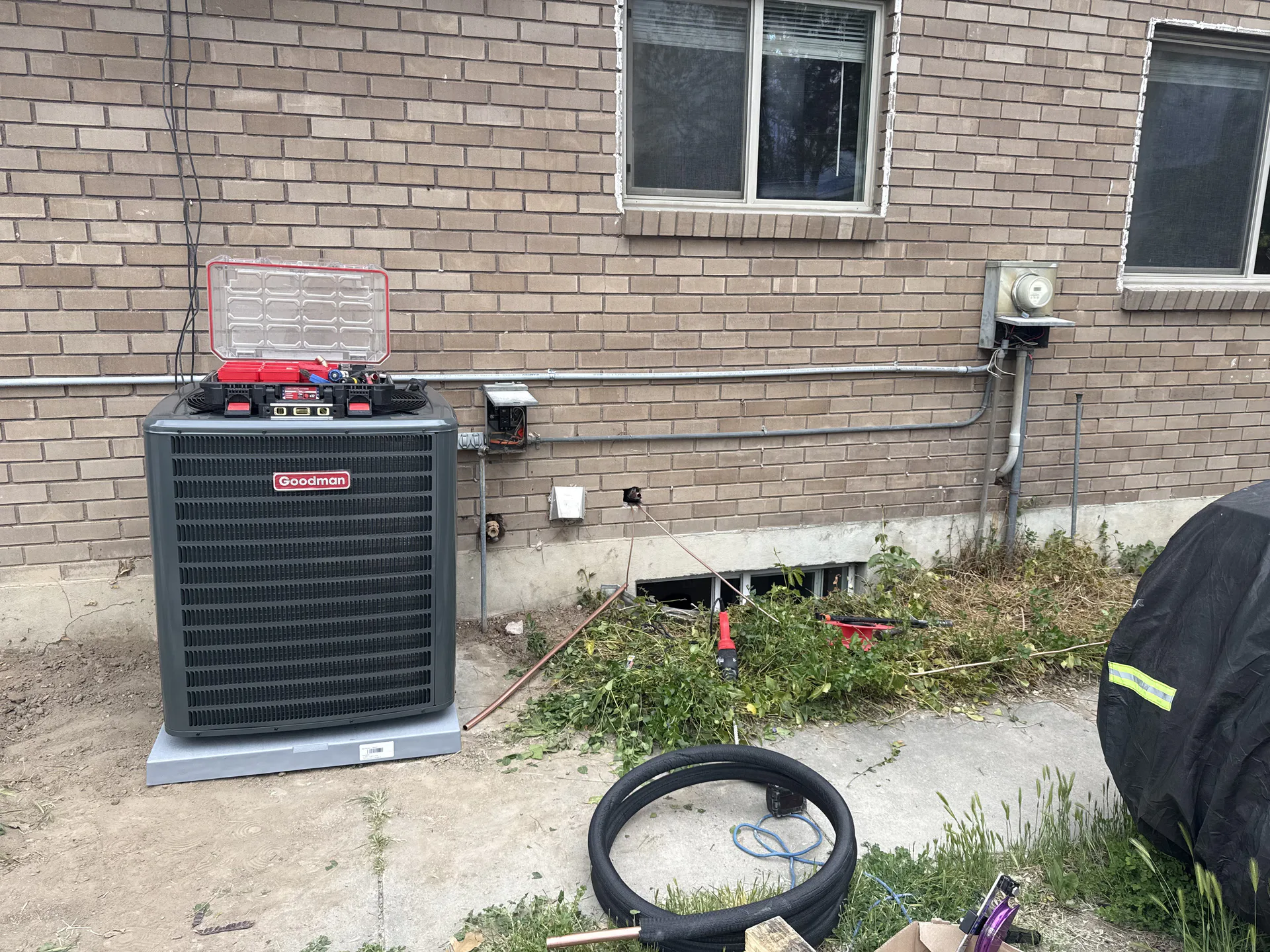
You bought your house in 2012. The AC unit was already a few years old. It's now 2026, and you've been telling yourself for three summers that “next year” you'll deal with it. Then comes the first 90°F day in May, the bedroom upstairs is 78°F at midnight, and you're back on the fence again. Here's the actual decision matrix — not a sales pitch.
The 5-Question Replace-vs-Repair Test
Answer these 5 questions before you call anyone for a quote:
- How old is the unit? Check the nameplate (a metal sticker on the side of the outdoor condenser). The serial number's first 4 digits typically encode month + year of manufacture (e.g.
0414= April 2014). Most residential AC units in Utah die at 13–17 years. At 14, you're in the “watch” window. - What refrigerant does it use? If the nameplate says R-22, the answer is replace — R-22 is fully phased out as of 2020, recovered stock costs $80–$200/lb, and a single recharge can run $600–$1,400. Newer systems use R-410A or the next-generation R-32; either is fine.
- How many repairs in the last 3 years? One repair: probably worth fixing. Two repairs: borderline. Three or more: replacement almost always wins on TCO. Track service receipts.
- How does the bill compare year-over-year? A failing AC bleeds efficiency. If your June–August bill is up $30–$80/month from 3 years ago and your usage is steady, the unit is now performing 15–25% below its rated SEER.
- Is the indoor coil leaking water or growing biological? The evaporator coil is half the system. If it needs replacement (typically $1,400–$2,200 just for that coil), you've spent half the cost of a new full system on a 14-year-old unit. Bad ROI.
The refrigerant clock
R-410A units are now on borrowed time: production phase-down means repair refrigerant gets pricier every year. A major R-410A repair in 2026 is money spent on a closing chapter.
The Math, Done Honestly
Average single-stage AC + furnace replacement in Utah, 2–5 ton: $7,500–$12,500 installed, before tax credits and rebates. With the IRA Section 25C credit ($2,000) plus typical Rocky Mountain Power rebates ($300–$800 depending on SEER tier), out-of-pocket lands $5,200–$9,500.
Compare against the cost of not replacing:
- Compressor failure (the worst case, age 12–16 is peak failure window): $2,400–$4,200 for the part + labor on an aging system that still needs replacement in 1–3 years anyway.
- Evaporator coil leak: $1,400–$2,200.
- Refrigerant recharge on R-22: $600–$1,400 per charge if you have a leak.
- Average annual energy bleed from a 14-year-old SEER-12 unit vs. a modern SEER2-15: ~$240/year for a 2,500 sq ft Utah home running mid-grade summer cooling.
A repair-it-til-it-dies strategy at age 14 typically costs $3,500–$5,500 over the next 3 years in incremental repairs + extra electricity, then the replacement still happens. So the decision isn't really “repair vs. replace” — it's “replace now or replace soon, with $3,500 on top.”
The Two Scenarios Where We Tell People to Wait
Not every 14-year-old unit needs replacement today. We've actually walked away from quotes when:
- The unit is R-410A, no current repair issues, and you're planning to sell within 18 months. Buyers don't pay extra for a new AC in Utah; they pay full asking with a working AC. Spending $8,000 to recover $1,500 in resale price isn't math.
- The system was right-sized at install (Manual J calculation done, ductwork sealed) and is just old, not failing. A well-designed system can run 16–18 years. We can extend its life with a tune-up + a capacitor refresh for $300–$450 if there are no other red flags.
If You Replace, Here's What Not to Cheap Out On
- Manual J load calculation. Most contractors skip it. Skipping it gives you an oversized AC that short-cycles, never dehumidifies, and dies early. Cost: included with us. If a contractor says they don't need it because they “know what size you need from looking,” walk away.
- Ductwork audit. Replacing the AC without checking ductwork leakage is like buying premium gas for a car with a hole in the tank. Most Utah homes lose 15–30% of conditioned air to leaky ducts.
- Variable-speed blower if the budget allows. The price difference (typically $400–$800) pays back in 2–3 summers via humidity control and quieter operation.
Bottom Line
If your AC is 14+ years old, on R-22, has had 2+ repairs in the last 3 years, or your summer bill is climbing, replacement now beats replacement in August. Get the Manual J load calculation done, stack the IRA tax credit and Rocky Mountain Power rebate, and you're looking at $5,200–$9,500 out-of-pocket for a system that runs 15–18 years. Book a free in-home estimate — we'll do the load calc, walk your ductwork, give you written numbers, and you decide. No pressure.
Related HVAC services
Need Help With This?
Our team is ready to help with expert hvac services across Utah.